The Industrial Revolution
The question
Section titled “The question”Why did sustained per-capita growth begin in late-18th-century Britain rather than somewhere else, sometime else?
Why it matters
Section titled “Why it matters”Sustained per-capita growth is the single most important fact about the modern world. Before roughly 1800, real income per head in every society on earth — China, India, the Ottoman world, Europe — fluctuated within a Malthusian band that hadn’t moved much in two thousand years. After 1800, in some places, it didn’t stop rising. The compound effect is a roughly 20–30× increase in real consumption per head in the now-rich world over two centuries, on top of a population explosion. Everything that follows — the Great Divergence between regions, the convergence and non-convergence puzzles of the 20th century, the development-economics literature on why poor countries are poor — is downstream of this one event. Understanding why it happened where and when it did constrains every theory of long-run growth.
Periodization & geographic scope
Section titled “Periodization & geographic scope”The textbook periodization runs 1760–1840 in Britain (initially England; Scotland follows). The conventional opening signals are Watt’s separate condenser (1769), Arkwright’s water frame (1769), and the early Boulton & Watt installations of the 1770s; the conventional close is the railway boom and the dominance of the factory system by the 1840s.
Almost every part of that periodization is contested. The “long IR” pushes the start back into the late-17th-century coke-iron and Newcomen developments and forward through the second IR (chemicals, electricity, steel) into the 1870s. The “industrious revolution” school (de Vries 2008) argues a behavioral and household-economic transformation predates the technological one by a century. The Crafts–Harley quantitative work (Crafts & Harley 1992) argues that aggregate British growth was modest until well into the 19th century and that the “revolution” framing overstates the discontinuity.
Geographically, the debate is whether to explain Britain or to explain Northwestern Europe. The “Britain-only” view (Allen, Wrigley) emphasizes a peculiar British factor endowment. The “European” view (Mokyr, McCloskey, North) emphasizes ideas, institutions, or culture that were broadly European but found their first application in Britain. The Great Divergence debate overlaps heavily here — the China/India comparison sharpens any explanation of why-not-elsewhere.
The numbers, in dispute
Section titled “The numbers, in dispute”A few headline magnitudes anchor the debate, but the data themselves are actively contested. Treat with skepticism.
Real GDP per capita, in 2011 international dollars (Maddison Project Database 2023, the latest release; the earlier Maddison Project 2020 release shows materially different numbers especially for the 19th century):
| Year | United Kingdom | Netherlands | China | India |
|---|---|---|---|---|
| 1500 | $1,697 | $2,332 | $1,207 | n/a |
| 1700 | $2,412 | $3,377 | $1,543 | $1,162 |
| 1820 | $3,306 | $3,006 | $882 | n/a |
| 1870 | $5,829 | $4,422 | $945 | $850 |
| 1913 | $8,212 | $6,454 | $985 | $1,073 |
| 1950 | $11,061 | $9,558 | $799 | $987 |
These are the live 2023 numbers. Note three things that surprise readers familiar with the older synthesis:
- Netherlands led England by per-capita GDP through ~1700. The Dutch Golden Age was richer per head than contemporary England; English overtaking is an 18th-century phenomenon.
- Chinese per-capita GDP fell from a Northern-Song peak through the Ming and Qing. The 2023 release incorporates the Broadberry-Guan-Li reconstruction, replacing the older “China constant at $600” placeholder.
- Indian per-capita GDP fell across the colonial 19th century, from $1,162 in 1700 to $850 in 1870, before recovering modestly. The reciprocal of British industrial rise.
Aggregate growth rates (Crafts-Harley revised series, then Broadberry et al. extension):
| Period | British real GDP per capita growth (annualized) |
|---|---|
| 1700–1760 | ~0.2% |
| 1760–1820 | ~0.3–0.5% |
| 1820–1870 | ~1.0–1.2% |
| 1870–1913 | ~1.0% |
Two specific things the numbers will mislead a casual reader about:
-
The “China at $600 across centuries” series is an artifact, not data — but it has been retired. Maddison’s 2009 estimates showed Chinese per-capita GDP holding constant at exactly $600 from 1500 through 1820. This was Maddison’s working assumption when he had no underlying Chinese data — a placeholder filling in a gap, not a measurement. The current Maddison Project Database 2023 has incorporated the Broadberry-Guan-Li (2018) reconstruction (drawing on actual Chinese sectoral data back to 980 CE), and the placeholder is gone. But the older series remains in pre-2018 textbooks and in many cross-disciplinary citations; treat any “China = $600 in 1820” reference as Maddison-2009 vintage.
-
The Crafts-Harley downward revision didn’t reach textbooks for a generation. The “British IR took off at ~1% per year per capita through 1760–1830” image survives in popular and cross-disciplinary writing (and even in some economics textbooks) decades after the Crafts (1985) revisions established lower numbers. When you encounter the higher figures, suspect a Rostow-vintage source.
The California-school parity claim and the Broadberry revisionist counter are at root a dispute about which series these reconstructions ought to be defaulting to.
Canonical charts
Section titled “Canonical charts”Three figures that anchor the debate quantitatively, each rendered from the underlying public datasets.
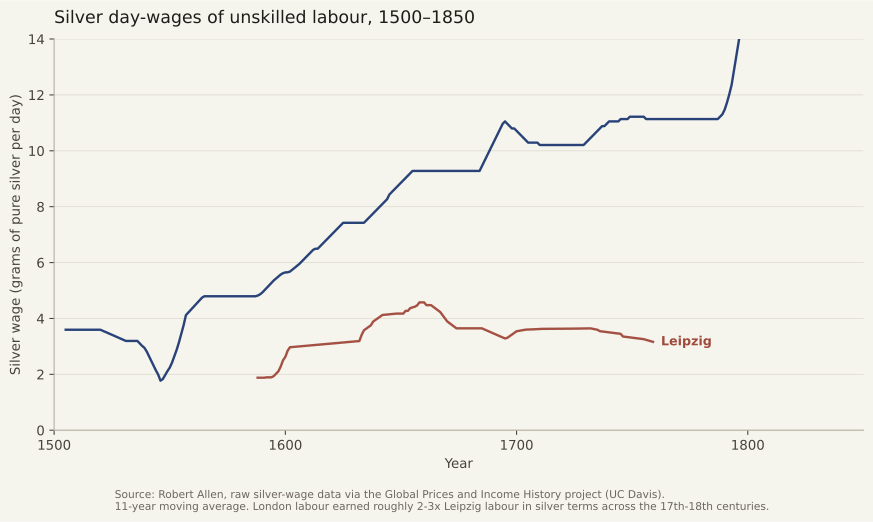
Figure 2 — Silver day-wages of unskilled labour in London (building labourer) and Leipzig (unskilled), 1500–1850, smoothed with an 11-year moving average. London labour earned ~10g of silver per day by 1700 vs. ~3g in Leipzig — the wage gap that anchors Allen’s high-wage thesis. Source: Allen wage series via the Global Prices and Income History project (UC Davis).
Data table
| Period | Coal | Firewood | Draught animals | Human | Wind & water | Total |
|---|---|---|---|---|---|---|
| 1561–70 | 6.9 | 21.5 | 21.1 | 14.9 | 0.8 | 65 |
| 1600–09 | 14.5 | 21.8 | 21.4 | 19.2 | 1.1 | 78 |
| 1650–59 | 39.1 | 22.2 | 27.7 | 26.1 | 1.8 | 117 |
| 1700–09 | 84 | 22.5 | 32.8 | 27.3 | 2.4 | 169 |
| 1750–59 | 140.8 | 22.6 | 33.6 | 29.7 | 4.1 | 231 |
| 1800–09 | 408.7 | 18.5 | 34.3 | 41.8 | 13.8 | 517 |
| 1850–59 | 1,689.1 | 2.2 | 50.1 | 67.8 | 26.1 | 1,835 |
Position map
Section titled “Position map”The live explanatory schools, with one-line theses. Click through for the case in full.
| Position | One-line thesis | Status |
|---|---|---|
| Coal & resource geography | Britain's accessible coal endowment plus "ghost acres" from the New World broke the organic-economy energy ceiling. | mainstream |
| High wages & induced innovation | Britain's uniquely high wages relative to cheap energy made labor-saving capital-intensive innovation profitable to invent and adopt. | mainstream |
| Useful knowledge & the Industrial Enlightenment | A culture of open scientific exchange — "useful knowledge" — built a feedback loop between savants and fabricators that other societies lacked. | mainstream |
| Upper-tail human capital & bricolage | An unusually deep bench of skilled artisans and mechanical engineers — not formal science, not mass literacy — drove the early IR's incremental innovations. | mainstream |
| Bourgeois dignity | A change in rhetoric — the moral revaluation of merchants, innovators, and commerce in 17th–18th-century NW Europe — unlocked everything else. | heterodox |
| Institutions | The Glorious Revolution credibly committed the English state to property rights, enabling investment-led growth. | contested |
| Genetic selection | Centuries of differential reproduction by the propertied middle class diffused "bourgeois" behavioral traits through the English population. | heterodox |
| Empire, slavery & unequal exchange | Atlantic slavery and extractive empire generated the capital, demand, and raw materials that financed industrialization. | contested |
| State capacity & the fiscal-military state | Britain's tax-raising, debt-issuing, navy-floating state was the precondition for everything else. | mainstream |
| Meta: no revolution / gradualism | There was no "revolution"; aggregate growth was slow until ~1830, and the IR is a Whig periodization imposed in retrospect. | contested |
| Rehabilitating the Industrial Revolution | The IR was a genuine discontinuity in industrial structure, labour organization, regional specialization, women's and children's work, and political economy — even if aggregate GDP growth was modest. | contested |
| The Protestant ethic | Max Weber's classic thesis that Protestantism — and especially its ascetic Calvinist forms — produced the cultural disposition that made Northwestern European capitalism possible. Largely deflated by modern empirical work but still in popular and cross-disciplinary circulation, and instructive in its failure. | fading |
| The Agricultural Revolution | A century or more of rising English agricultural productivity (enclosure, convertible husbandry, Norfolk four-course, selective breeding) freed labour for industry and fed an urbanizing population. The IR's necessary precondition. | mainstream |
| Finance, credit & banking | A dense, increasingly sophisticated British financial infrastructure — country banks, the discount market, joint-stock forms, the Bank of England, bills of exchange — provided the working capital and intermediation that industrial growth required. | contested |
These positions are not mutually exclusive. Most working economic historians stack two or three (e.g., Allen’s coal+wages+empire combo, or Mokyr’s culture+institutions+human-capital combo). The disagreements are about weight and necessity, not usually about existence.
Live cruxes
Section titled “Live cruxes”The three or four questions where the schools actually clash, where new evidence would move the field:
-
Coal: necessary or sufficient or merely useful? Was cheap coal a cause of the IR, an enabler once the IR was underway, or simply geographically convenient? China had coal in the wrong place (Shanxi, far from Yangtze markets); the Dutch had peat but no coal and stalled; Belgium had coal and didn’t lead. The position depends on how counterfactual you’re willing to be about transport costs. See Wrigley 2010 vs. the Pomeranz–Allen exchanges.
-
Did wages or culture drive the supply of innovators? Allen’s high-wage thesis explains demand for labor-saving machinery but is famously thin on supply — where do the inventors come from? Mokyr’s Industrial Enlightenment and the upper-tail-human-capital literature answer the supply side. The crux: do you need the cultural/human-capital story at all if the price story is strong enough? Kelly, Mokyr, & Ó Gráda (2014, 2023) have argued that British wages weren’t actually that high in efficiency-units terms once you account for skill, which would gut the Allen story.
-
Did the Glorious Revolution actually change anything? The North–Weingast claim is that 1688 produced credible commitment to property rights, which lowered borrowing costs and unleashed investment. Critics (Clark, Hoppit, Coffman) argue interest rates and property security barely budged in 1688, and that the “institutional” turn over-reads a constitutional event whose economic consequences were modest and slow.
-
Was empire load-bearing or peripheral? The Williams thesis — that Atlantic slavery financed industrialization — was buried by economic historians in the 1970s–80s (e.g., Engerman) on the grounds that slave-trade profits were too small a share of British GDP to matter. Recent work (Inikori, Beckert, Berg) revives the argument by widening the lens to include the cotton complex, demand effects, and shipping/finance ecosystems. The crux is methodological: what counts as “the empire’s contribution”?
-
The meta-crux: was there a “revolution” at all? The Crafts–Harley quantitative work showed aggregate British growth was modest until well into the 19th century. The de Vries “industrious revolution” repositions the key behavioral change a century earlier. If the answer is “no big bang,” the very framing of the IR debate may be the problem.
Meta-debate: was there even a revolution?
Section titled “Meta-debate: was there even a revolution?”A long counter-current argues that the “Industrial Revolution” is a Victorian construct. Three flavors:
- Quantitative gradualism — Crafts, Harley, and the more recent Broadberry GDP reconstructions show that British per-capita growth was around 0.3–0.5%/year in the late 18th century, accelerating to ~1%/year only by the mid-19th century. There’s a transition, but not a “revolution” in the sense of sudden discontinuity.
- Industrious revolution — de Vries (2008) reframes the 17th–18th centuries as a household-level shift toward more market-oriented labor (longer hours, more wage work, more women & children in the labor market) to consume new goods. The “revolution” was behavioral, not technological, and predates the IR by a century.
- No-take-off — The most extreme version (Komlos, Mokyr in places, certain biological-standard-of-living revisionists) notes that real wages and stature for British workers stagnated or fell in the early IR. From the worker’s-eye view, there was no obvious break.
These are all live and not knock-down arguments against a “Why the IR” question — they are arguments about what the IR is. The position map above presupposes that there is something to explain, even if it’s a less abrupt transition than the Toynbee framing suggested.
Reading list
Section titled “Reading list”The minimum stack to take the debate seriously, ordered roughly by how foundational each is.
- Allen (2009), The British Industrial Revolution in Global Perspective — the high-wage / cheap-energy thesis, with the comparative price data that sets the empirical bar.
- Mokyr (2009), The Enlightened Economy — the Industrial Enlightenment / useful-knowledge case, plus a synthesis of the broader debate.
- Pomeranz (2000), The Great Divergence — the Sino-European comparison that reset the question and made geography/coal central.
- Wrigley (2010), Energy and the English Industrial Revolution — the organic-to-fossil-energy transition framing.
- Clark (2007), A Farewell to Alms — the genetic / cultural-selection case (and a useful gateway into the demographic literature).
- McCloskey (2010), Bourgeois Dignity — the rhetorical/ideational case against materialist explanations.
- Acemoglu & Robinson (2012), Why Nations Fail — the institutional-commitment case (and the popular synthesis of a long literature with North).
- Crafts & Harley (1992) — the gradualist / quantitative-revisionist baseline.
- de Vries (2008), The Industrious Revolution — the household-economy reframing.
- Mokyr (2002), The Gifts of Athena — the prequel to Enlightened Economy; the useful-knowledge / propositional-vs-prescriptive distinction.